Cool Cholo N Chola Drawings Dancing
A cholo or chola is a member of a Chicano and Latino subculture or lifestyle associated with a detail set of apparel, beliefs, and worldview which originated in Los Angeles.[1] A veterano or veterana is an older fellow member of the aforementioned subculture.[2] [3] [4] Other terms referring to male person members of the subculture may include vato, and vato loco.[5] [6] Cholo was get-go reclaimed by Chicano youth in the 1960s and emerged as a popular identification in the tardily 1970s.[1] [vii] The subculture has historical roots in the Pachuco subculture, merely today is largely equated with anti-social behavior, criminal behavior and gang activity.[8] [9]
Usage of terms [edit]
Historical [edit]
Cholo was originally used to announce a racialized individual of lower socioeconomic status. Information technology first emerged in the early 17th century as a term used past Spanish colonizers as follows: "The child of a Black male and an Indian female, or of an Indian male and Blackness female, they call mulato and mulata. The children of these they call cholos. Cholo is a word from the Windward Islands; it means dog, not of the purebred variety, but of very disreputable origin; and the Spaniards use it for insult and vituperation."[x] In the latter part of the 19th century, it referred to "culturally marginal" mestizos of Native American origin,[11] being applied to "peasant mestizos equally a pejorative indigenous characterization to distinguish the rich, the upwardly mobile, and other aspiring members ... from the working class."[vii]
Clearly the origin is circuitous, Jose Cuellar writes in 1982:
Racial and cultural condition, forth with social class are reflected in the term cholo itself, which was adopted in California in the 1960s by youth following the pachuco tradition, every bit a label for that identity (Cuellar 1982). In 1571, Fray Alonso de Molina, in his Nahuatl vocabulary (Vocabulario en Lengua Castellana y Mexicana Y Mexicana y Castellana), divers the word xolo equally slave, servant, or waiter. The Porrúa Dictionary defines cholo, as used in the Americas, as a civilized Native American or a half-breed or mestizo of a European father and Native American mother. The word has historically been used along the borderland equally a derogatory term to mean lower course Mexican migrants, and in the rest of Latin America to hateful an acculturating Indian or peasant.[12]
Pachucos [edit]
During the 1930s and 1940s, the Chicano look known as pachuco appeared and was associated with the zoot suit and hep cat subcultures.[13] The press at the fourth dimension defendant the pachucos in the U.S. of gang membership, petty misdeed, and a lack of patriotism during World State of war Two leading to the Zoot Suit Riots.[fourteen] Standing until the early on 1970s, the typical Chicano hairstyle was a variant of the pompadour, piled loftier on the head and kept in identify with large quantities of wet-look gel.
Reclamation [edit]
In the 1960s, the Chicano Movement turned the term cholo into a manner to express Chicano pride and identity.[one] [15] Since then, it has been more widely reclaimed amidst Latinos of mixed heritage.[vi]
Style [edit]

Cholo style, originating from Chicanos in the Usa, tin can be seen here every bit adopted by men from Cacos 13, a gang from the La Neza (Nezahualcoyotl) neighbourhood of Mexico City.

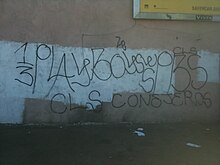
'Eastside Playboys' Cholo style graffiti in Los Angeles.
Cholo [edit]
Cholo mode is frequently associated with wearing some combination of a tartan, flannel, or Pendleton shirt buttoned at the top over a white T-shirt or tanktop, a hair net over brusk hair combed straight back or a shaved head, a bandana tied around the head and pulled down but above the eyes, reverse baseball caps, dark sunglasses, loose-fitting khaki pants (chinos) or shorts, long chains, long socks, white lawn tennis shoes, and stylized tattoos.[8] [16] [17] The style has been described as both a necessity and a style of empowerment.[i] Cholo style is represents a large part of cholo subculture, although it does not represent it in its totality.[5] Cholo fashion has been identified every bit combining the loose-fitting comfort of the traditional huipil and baggy draping of the zoot suit donned by the pachuco.[seven]
Footwear originally included Stacy Adams dress shoes, and "biscuits" (pointy-toed dress shoes). Modern cholos tend to habiliment athletic shoes, such every bit Converse, Nike Cortez, Nike Air Force 1, Vans, Fila, Adidas Stan Smith, Onitsuka Tiger sideslip-on firm shoes, K Swiss or Huarache sandals. Popular cholo brands include Dickies, Ben Davis, Joker, Lowrider, and Bighouse.[ citation needed ]
Some cholos, particularly older cholos, wishing to adopt a more traditional look, wear formal wear inspired by zoot arrange fashion, including dress shirts with suspenders, and fedoras, merely may still retain cholo elements such as a bandana or hair net. In South Texas, cholos are sometimes referred to as chucs or chukes. This term is short for pachucos.[ citation needed ] Tejano cholos typically brand heavy use of starch on their pants but so practice traditional Tejanos.[ citation needed ]
Adopting cholo style has likewise been identified as a way for youths to assert their Chicano identity, especially for those who are only English-speaking. James Diego Vigil analyzes how some barrios in the United States that were predominately Spanish-speaking in the 1960s became by and large English language-speaking by the 1980s. Some use cholo way to deny their anglicization or cultural assimilation besides as to separate themselves from affiliating with Mexican migrants. Equally stated past Vigil, "much of this interethnic friction revolves effectually ... competition for deficient job resources, especially between members of the depressed underclass and desperate immigrants."[11] Nevertheless, it is also cultural, with "Mexicans making fun of a Chicano's inability to speak 'proper' Castilian and conversely" Chicanos and cholos sometimes using interethnic pejoratives against Mexican migrants, such equally "chuntaro" and "wetback."[11]
Cholo style graffiti is a unique writing and lettering fashion.[xviii] The artist Chaz uses a calligraphic variant in his works. Retna'south piece of work is inspired past Cholo messages. This designation may also be associated with black ink tattoos, commonly involving calligraphy and art. A cholo might too stereotypically ain a lowrider. Another staple of cholo way is long hair tied into braids as depicted by player Danny Trejo.
The cholo/a subculture has spread to cities in the United states of america with large Chicano or Latino populations, including New York Urban center. It has also been adopted as a subculture in Japan[xix] and has been introduced to Mexico (such as in Nogales, Sonora, and Mexico Urban center) in a modified grade every bit documented in the 2015 photo documentary volume Cholumbianos by Amanda Watkins.[20]
Chola [edit]
Chola way is ofttimes associated with wearing some combination of a long white T-shirt or tanktops, sometimes worn under plaid shirts, baggy jeans, flat blackness shoes, long hair, spiked bangs, dark or heavy eyeliner, and dark lipstick and lip liner.[ane] Chola style has been identified as exhibiting "a radically criminalized femininity, situating them in the purview of official and unofficial policing as well every bit legal and extralegal sanctions." Chola style is perceived with less menace than cholo style, although it has been described as more than direct challenging to the gendered expectations placed on women.[1]
Criminalization [edit]
Chicano/a youth who adopt a cholo or chola culture endure criminalization, police and other institutions equate cholo style with a 'gang member'.[9] While older residents in barrios initially embraced cholasouth and cholos equally "a larger subculture not necessarily associated with crime and violence (only rather with a youthful temporary identity), police enforcement agents, ignorant or disdainful of barrio life, labeled youth who wore clean white lawn tennis shoes, shaved their heads, or long socks, equally deviant."[eight]
Gilberto Rosas describes the fashion of cholos as a style which has become criminalized–"a radically conditioned choice to be visibly and self-consciously identified with a criminalized class"[1] Because the way cholo way has been criminalized, it commonly excludes cholos from employment opportunities while opening them upwards to routine police harassment and arrest.[1]
In a study of cholos in a Southern California community renamed "Riverland" (to protect the confidentiality of the participants),[21] Victor Rios and Patrick Lopez-Aguado discuss how cholos are marked equally "homo targets" and come to understand their own perceived criminality.[9] Rios and Lopez-Aguado identify that cholos feel routine harassment and arrest past law. As stated past Rios and Lopez-Aguado, cholos remain "steadfast in their stylistic stance because their visible opposition appeared to be the unabridged point," as it is "intentionally oppositional to the mainstream." Cholos are aware that their style will non grant them social mobility and frequently maintain their style after having been rejected past multiple institutions, including "family, schools, police, and the labor marketplace." Rios and Lopez-Aguado explicate:
Nonetheless, the feeling of dignity and affirmation frequently outweighed the punitive consequences meted out by the state... Witting of the few opportunities to find legitimate career paths, Latino youth adopted appearances they knew would cake them from the low-level service positions they were expected to fill. They tapped into racist fears of their inherent criminality to create a public impression that would counter the prototype of the submissive, stigmatized servant. In a racialized, hyperexploited service economic system, these youths deliberately put themselves out of service to retain their dignity.[ix]
Media [edit]
Film [edit]
- At that place is a reference to "The Cholo" in Assault on Precinct thirteen (1976), although information technology is used to refer specifically to a blood oath instead of a Mexican person.
- Boulevard Nights is a 1979 American neo noir crime flick directed by Michael Pressman. It is near life in Due east Los Angeles and its street gangs.
- Born in East L.A. is a 1987 American one-act film written and directed past Cheech Marin, which makes several references to Cholos, their manner of dress, and speaking.
- Stand up and Evangelize is a 1988 American drama moving picture based on the true story of a high school mathematics instructor in LA.
- Blood In Blood Out is a 1993 American ballsy crime drama film about Cholo prison house life directed by Taylor Hackford.
- Mi Vida Loca is a 1993 American drama motion picture directed and written by Allison Anders, about Chicanas growing up in the Echo Park department of Los Angeles.
- The 1993 activeness film Falling Down features a cholo gang as minor antagonists in the first act, who harass Bill Foster (Michael Douglas) and after execute an unsuccessful drive-by shooting against him.
- The biographical film Selena (1997) features a scene where ii Cholos recognize Selena (Jennifer Lopez) and offer to help her afterwards her bout charabanc got stuck on the side of a highway.
- The flick Side by side Friday (2000) features three Cholo brothers who serve as antagonists to the chief characters.
- In the moving picture Napoleon Dynamite (2004), Nano and Arturo De Silva play characters only referred to equally "Cholo No. 1" and "Cholo No. two".
- In the film Knocked Up (2007), Ben (Seth Rogen) and Pete (Paul Rudd) have a back and along joke where Pete says that Ben '...got dressed up like a Cholo on Easter to come to this party."
- The film La Mission (2009), starring Benjamin Bratt, is an accurate representation[ who? ] of the fashion, language, cars and music associated with the Cholo culture.[ citation needed ]
- In Logan (2017), the titular grapheme begins the film defending his limo from individuals to whom Donald Pierce derogatorily refers every bit "Cholos," who are trying to strip the automobile's rims.
Games [edit]
- In the video game Yard Theft Auto: Vice Urban center Stories, there is a street gang called the Cholos who resemble the stereotypical gangster image of a Cholo.[22]
- In the video game Grand Theft Auto: San Andreas, there are two gangs called the Aztecas and Vagos. One of the supporting characters, Cesar Vialpando, is a member of the Aztecas and serves as a friend to the main graphic symbol Carl "CJ" Johnson.
- In the video game 1000 Theft Auto V, several Latino street gangs are depicted, including the Vagos, Aztecas, and the Marabunta Grande.
Literature [edit]
- The Adventures of Chico Loco, a comic strip created by David Gonzalez popular in the belatedly 1990s and early on 2000s led to the production of toys known equally "Homies," which accept go collectibles beyond the world and have inspired numerous imitations. The Los Angeles Constabulary Department stated that the toys promoted "gang life."[6]
Music [edit]
- LA punk rock band The Dickies recorded "I'm a Chollo" for their album Dawn of the Dickies (1979).
- Prayers coined the term cholo goth to draw their electronic rock sound.[23] [24]
- Hip-Hop artists Delinquent Habits and Control Machete have been described equally representing the cholo subculture.[1]
- Cholo gained even further notoriety in 2007 in the United States with the song "Lean Like a Cholo" by Downwardly AKA Kilo.
- Chola style has been appropriated and adopted by Christina Aguilera, Gwen Stefani ("Luxurious" and "Hollaback Girl"), Cher, Madonna, Missy Elliot, Selena Gomez, FKA Twigs, and Rihanna.[16] [25] [6]
- Fergie's music videos "London Bridge" and "Glamorous" feature fill-in dancers dressed equally cholas.[25]
- Alejandro Aranda performed an original song chosen "Cholo Love" during his run on American Idol.
Television [edit]
- In Sons of Chaos (season 6), Tara leaves prison with a new haircut, about which she says, "All the cholas are wearing information technology".[ citation needed ]
- Entertainer Adore Delano often refers to herself and her mother equally Cholas in season 6 of RuPaul's Drag Race.[ citation needed ]
- In Mayans M.C., the motorcycles owned by EZ and Angel Reyes are refereed to as "cholos chops" by two members of a hostile club.
See likewise [edit]
- Eshays – A like Australian subculture
- Chav – A similar British subculture
- Pizza effect
References [edit]
- ^ a b c d due east f chiliad h i Rosas, Gilberto (2012). Barrio Libre: Criminalizing States and Delinquent Refusals of the New Frontier. Duke University Press. pp. 80–88. ISBN9780822352372.
- ^ Diego Vigil, James (Spring 1983). "Chicano Gangs: I Response To Mexican Urban Accommodation In The Los Angeles Expanse". Urban Anthropology. 12 (1): 45–75. JSTOR 40552988.
- ^ Gómez-Peña, Guillermo; Taccone, Tony (2003). Culture Clash in America. Theatre Communications Group. p. 144. ISBN9781559362160.
- ^ Christof, Tag (August 15, 2019). "Cruising low and tedious: The 'Lowrider Capital of the World' is seeing a rolling revival—thanks to local pride, pageantry, and hydraulics". Roadtrippers . Retrieved June 29, 2020.
- ^ a b Diego Vigil, James (2010). Barrio Gangs: Street Life and Identity in Southern California. University of Texas Printing. pp. 40–42, 113. ISBN9780292786776.
- ^ a b c d "13 Things Y'all Should Know About Cholo Civilization". we are mitú. November 7, 2018.
- ^ a b c Chavez Candelaria, Cordelia. Encyclopedia of Latino Popular Culture: Volume 1. pp. 160, 266.
- ^ a b c Plascencia-Castillo, José S. (2019). Gringo Injustice: Insider Perspectives on Police, Gangs, and Law. Routledge. pp. 154–69. ISBN9780367276065.
- ^ a b c d Rios, Victor Grand.; Diego Acuity, James; Patrick, Lopez-Aguado (2017). Human Targets: Schools, Police, and the Criminalization of Latino Youth. University of Chicago Press. pp. 75–85. ISBN9780226090993.
- ^ de la Vega, Garcilaso, Inca (1609). Los Comentarios Reales de los Incas. pp. ME.
- ^ a b c Acuity, James Diego (1988). Barrio Gangs: Street Life and Identity in Southern California . Austin: Academy of Texas Press. ISBN0-292-71119-0.
- ^ Cuellar, J. (September 21, 1982). The Rise and Spread of Cholismo as a Border Youth Subculture. Southwest Border Regional Conference's Third Almanac Binational Edge Governors' Conference, Tijuana, Baja California, Mexico: Unpublished manuscript.
- ^ LA Almanac
- ^ Zoot suit riots media Archived March 4, 2016, at the Wayback Motorcar
- ^ Alexandra de F. Szoenyi, Five. (January 17, 2020). "Cholo: 23 Facts About the History of the Word". Hip Latina . Retrieved June 23, 2020.
- ^ a b Mayorga, Luanne (2014). Cholo Fashion. Rowman & Littlefield. pp. 81–82. ISBN9780759121508.
- ^ Luis Aldama, Frederick (2013). "Glossary". The Routledge Concise History of Latino/a Literature. Routledge. ISBN9780415667876.
- ^ Chastanet, François (2009). Cholo writing : Latino gang graffiti in Los Angeles. Dokument Press. ISBN978-91-85639-21-2. OCLC 318421538.
- ^ "LOOK: Japanese 'Cholos' Encompass Lowriders And Chicano Mode". HuffPost. September 11, 2012. Retrieved September 23, 2021.
- ^ Watkins, Amanda (2014). Cholombianos. Trilce Ediciones. ISBN978-607-7663-64-v. OCLC 880356978.
- ^ Rios, Victor M. (2017). Human Targets: Schools, Police force, and the Criminalization of Latino Youth. University of Chicago Printing. p. 14. ISBN9780226091044.
- ^ Beale, Lewis (August six, 2006). "The immature stars of an award-winning new film reverberate on their Mexican roots". Us Weekend.com. Archived from the original on January 5, 2013. Retrieved January 11, 2009.
- ^ "Cholo goth". San Diego Reader. November half dozen, 2013. Retrieved May xxx, 2014.
- ^ Lisa Derrick (March 25, 2014). "Prayers: Cholo Goth Is 'Fix to Drain' and to Stone | Lisa Derrick". Huffingtonpost.com. Retrieved May 30, 2014.
- ^ a b Vineyard, Jennifer (July 12, 2006). "Black Eyed Peas' Fergie Gets Rough And Regal In First Video From Solo LP – Music, Celebrity, Artist News". MTV. Retrieved January sixteen, 2012.
Source: https://en.wikipedia.org/wiki/Cholo_(subculture)
0 Response to "Cool Cholo N Chola Drawings Dancing"
Enregistrer un commentaire